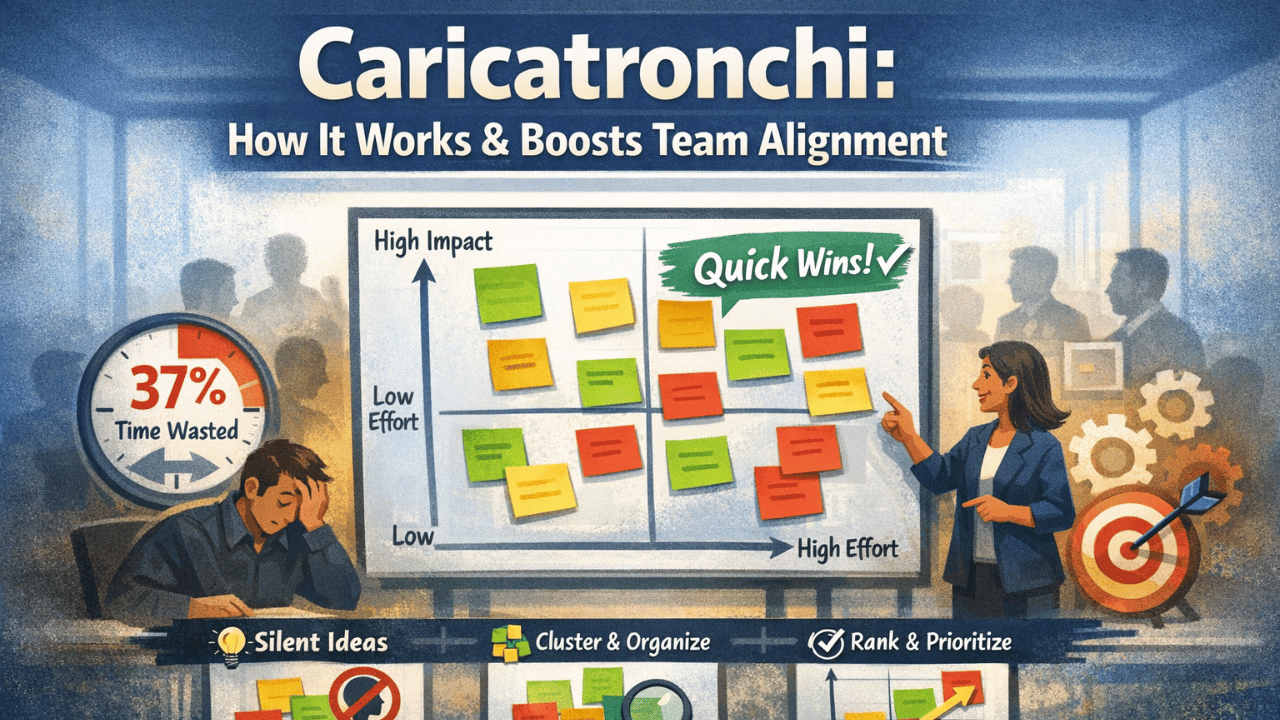
Here’s a hard truth: we waste nearly 37% of our time in meetings on misalignment. I’ve felt that frustration, watching a project stall because the core message got lost in translation. What if there was a method to instantly clarify your team’s vision, spotlight the true priorities, and cut through the noise? That’s where Caricatronchi comes in. Forget complex theories.
This is a practical, visual framework used by agile teams to force clarity and make decisions stick. I’ll show you its three simple components and exactly how to run your first session next week.
Let’s turn that misalignment stat on its head.
The Core Problem: Why Communication Fails
Before we dive into the Caricatronchi methodology, let’s acknowledge the elephant in the room. Modern teams are drowning in data, opinions, and competing priorities. A brainstorming session can generate a hundred ideas, but without a clear mechanism for evaluation, the loudest voice often wins—not the best idea.
This is where traditional methods fall short. Vague discussions, unranked lists, and endless debate cycles sap productivity. What you need is a structured prioritization technique that is both visually engaging and rigorously objective. You need a system that moves a team from divergent thinking to convergent action. That system is Caricatronchi.
Defining Caricatronchi: More Than Just a Fun Name
So, what is Caricatronchi? At its heart, it’s a visual collaboration framework designed for team decision-making. The name might sound novel, but its principles are rooted in proven agile practices and design thinking. Think of it as a hybrid: part affinity mapping, part effort-value matrix, but with a unique, streamlined twist that accelerates group consensus.
The primary goal of this project management tool is to create a shared, tangible landscape of ideas. It transforms abstract concepts into movable, discussable artifacts, making the path to strategic alignment not just clear, but unavoidable.
The Three Pillars: How the Caricatronchi Framework Operates
The magic of Caricatronchi lies in its simplicity. It works by enforcing three sequential stages. Skipping one breaks the model. Here’s the breakdown:
1. The Silent Generate Phase
This is where you diverge. Every session starts with a central question or problem statement (e.g., “How can we improve the customer onboarding experience?”).
-
Activity: Participants silently write down their ideas, one per card or digital sticky note. No talking is allowed.
-
Why it Works: This eliminates anchor bias and ensures all voices are heard equally, not just the most extroverted. It’s a cornerstone of inclusive brainstorming.
2. The Thematic Cluster Phase
Now, we start to find patterns. All ideas are displayed in a shared space.
-
Activity: As a group, participants move the notes into natural groupings. Someone might say, “These three seem related to tutorial content,” and move them together. This is affinity diagramming in action.
-
Outcome: You no longer have 50 disparate ideas. You have 5-7 core thematic clusters. This is your first major step toward idea organization.
3. The Forced Ranking Grid
This is the convergent engine of Caricatronchi—where decisions are made. You take your clustered themes and place them on a simple 2×2 grid. The axes are critical and should be defined for your specific goal. Common pairings are:
-
Impact vs. Effort (How much value does this deliver vs. how hard is it to do?)
-
User Value vs. Business Value
-
Urgency vs. Importance
-
Activity: The team debates and collectively places each major theme onto the grid. This forces difficult conversations and makes trade-offs explicit.
-
The Punch: The “Caricatronchi” moment happens here. The framework literally forces a visual ranking. Items in the high-impact, low-effort quadrant (the “quick wins”) become your immediate action plan. This visual prioritization is unambiguous and owned by the entire team.
Implementing Caricatronchi: A Step-by-Step Guide
Let’s move from theory to practice. Here’s how you can run your first session.
What You’ll Need:
-
A clear problem statement.
-
A physical whiteboard & sticky notes, or a digital tool like Miro, Mural, or FigJam.
-
A diverse group of stakeholders (5-8 people is ideal).
-
Time: 60-90 minutes.
The Step-by-Step Process:
-
Frame the Challenge (5 mins): Clearly state the objective. Write it at the top of the board.
-
Silent Generation (10 mins): Everyone writes ideas. Encourage volume.
-
Share & Cluster (15 mins): Post all notes, then organize them into themes. Name each cluster.
-
Define Your Grid Axes (5 mins): As a team, agree on the two criteria for your 2×2 matrix. For most, Impact vs. Feasibility is a perfect start.
-
The Forced Ranking (20 mins): This is the crux. Discuss and place each thematic cluster on the grid. Require justification. This builds collective buy-in.
-
Define Next Actions (10 mins): Assign owners for the top-right quadrant (high-impact, high-feasibility) items. Document the outcome.
Why Caricatronchi Works: The Psychology Behind the Framework
This isn’t just a meeting trick. Its effectiveness is backed by principles of cognitive psychology and team dynamics.
-
Reduces Cognitive Load: By making ideas physical and visual, the framework offloads information from working memory. This frees the brain to evaluate and connect.
-
Minimizes Groupthink: The silent start and structured ranking prevent dominant personalities from steering the outcome prematurely.
-
Creates Tangible Artifacts: The final grid is a visual reference the team co-created. It serves as a lasting source of truth for project direction, eliminating “he said, she said” later on.
Common Pitfalls and How to Avoid Them
Even the best collaboration techniques can stumble. Here’s how to steer clear of common mistakes:
-
Vague Problem Statement: Garbage in, garbage out. Be specific. Instead of “Discuss marketing,” try “Identify the top three campaign themes for Q3.”
-
Skipping the Silence: Don’t let talkative participants jump ahead. Enforce the quiet ideation period—it’s non-negotiable.
-
Arguing Over Grid Placement Forever: Use dot voting if you’re stuck. Give each participant 3 dots to vote on where a contentious item should go. The framework aids decision-making, it doesn’t replace it.
-
Ignoring the Output: The biggest failure is not acting on the result. The grid must lead to immediate task assignment and sprint planning.
Caricatronchi in the Wild: Real-World Applications
This problem-solving framework is versatile. Beyond typical product development, I’ve seen it used successfully for:
-
Strategic Planning: Mapping out annual company OKRs and initiatives.
-
Process Improvement: Identifying the most painful bottlenecks in a workflow.
-
Content Strategy: Deciding which blog topics or video ideas to produce next.
-
Event Planning: Prioritizing features for a company conference.
In each case, Caricatronchi provided the structured workshop needed to move from overwhelming possibilities to a committed, aligned plan.
Conclusion
Caricatronchi is more than a process; it’s a commitment to smarter, more democratic work. It counters meeting fatigue by delivering genuine, actionable results that everyone supports. It turns the draining cycle of debate into a productive engine for consensus building.
You now know what it is and how it works. The next step is to try it. Schedule that 60-minute session with your team. Frame that challenging question. And watch as the noise fades away, leaving only a clear, visual path forward. The 37% of time you’ve been losing to misalignment is waiting for you to claim it back. Start with your first grid.