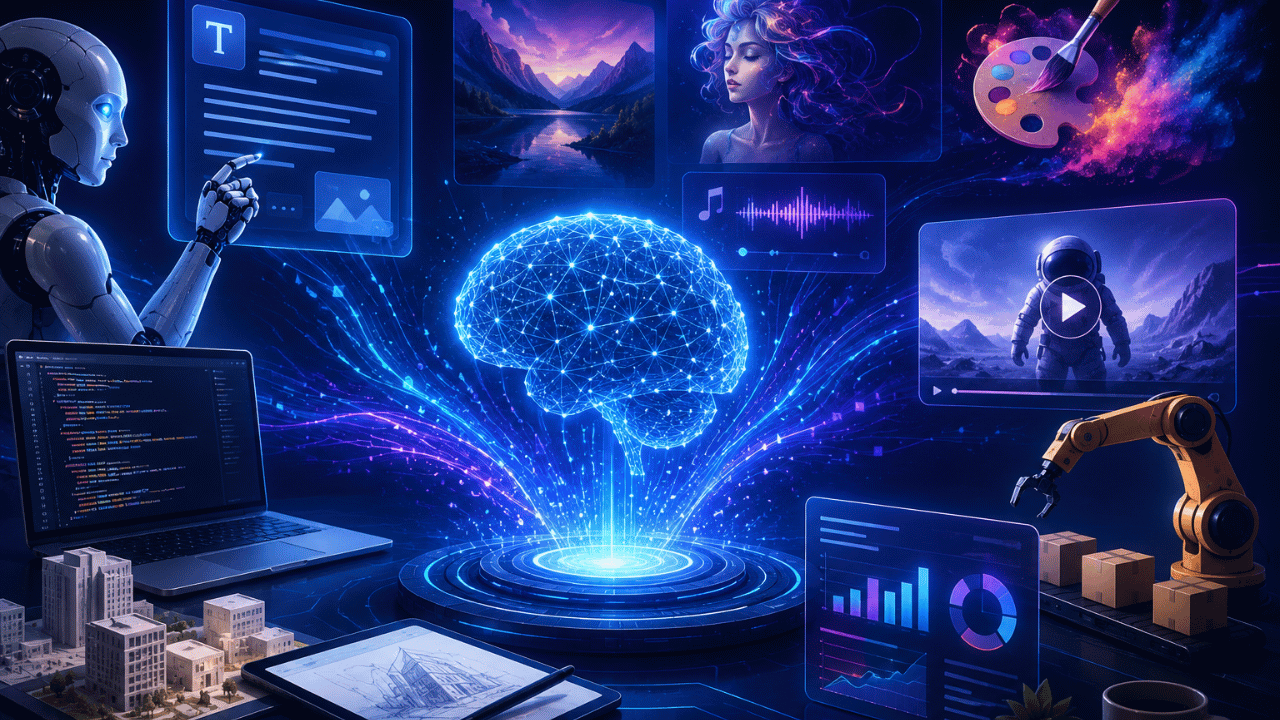
Generative AI is a type of artificial intelligence that creates new content — text, images, audio, video, and code — by learning patterns from massive datasets and using those patterns to produce original outputs in response to user prompts. In 2026, it has moved from a novelty into foundational infrastructure, reshaping how businesses operate, how creative work is produced, how scientific research is conducted, and how everyday people interact with technology.
If you had told someone in 2020 that within six years, AI systems would be writing production-ready code, generating photorealistic video from text descriptions, reasoning through complex scientific problems, and autonomously navigating the web to complete multi-step tasks — they would have called you delusional.
According to KASATA TechVoyager’s March 2026 analysis: “Here we are in early 2026, and generative AI has not only met those expectations — it has exceeded them in ways that continue to astonish even the researchers building these systems.”
This guide explains what generative AI actually is, how it works under the hood, the specific ways it is changing industries and everyday life in 2026, and the real concerns that accompany its rapid expansion.
What Is Generative AI?
Generative AI is a category of artificial intelligence that produces new content — including text, images, audio, video, code, and synthetic data — by learning statistical patterns from large datasets and using those patterns to generate original outputs that did not previously exist.
As Future Objects’ June 2026 analysis explained with a useful analogy: “Imagine a person who can read a recipe versus someone who can come up with a brand new dish from scratch — that’s the difference.” Traditional AI analyzes existing data to classify, predict, or recommend. Generative AI goes further — it creates something new from what it has learned.
The distinction from traditional AI matters practically: a traditional AI can tell you whether an email is spam. A generative AI can write the email. A traditional AI can identify a tumor in a scan. A generative AI can draft the clinical summary describing it.
How Does Generative AI Actually Work?
Generative AI works by training large neural networks on massive datasets of existing content — billions of text documents, images, audio recordings, or code files — allowing the model to learn the underlying statistical patterns of that content and use those patterns to generate new examples when prompted.
The most common architecture powering generative AI in 2026 is the Transformer — a neural network design introduced by Google in 2017 that processes entire sequences of data simultaneously rather than word by word, enabling it to understand context across long passages of text, image regions, or audio segments.
Here is a simplified version of how a large language model generates text:
- You provide a prompt — a question, instruction, or starting text
- The model converts your words into numerical representations called tokens
- It processes those tokens through billions of learned parameters — essentially statistical weights — that encode patterns from training data
- It predicts, token by token, what the most contextually appropriate next word or phrase is
- The output builds progressively until the response is complete
Importantly, the model is not retrieving stored answers. It is generating each response by applying learned patterns — which is why generative AI can produce novel text that has never existed before, and also why it can occasionally produce plausible-sounding but incorrect information.
The 4 Main Types of Generative AI in 2026
1. Large Language Models (LLMs) — Text Generation
LLMs are the most widely known form of generative AI — systems like ChatGPT (GPT-5.5), Claude (Sonnet 4.6), and Gemini (3.1 Pro) that generate text responses to written prompts. In 2026, these models handle far more than text: they reason through complex problems, write and debug code, analyze documents, browse the web, and coordinate multi-step tasks through agent frameworks.
2. Image Generation Models — Visual Creation
Models like Midjourney, Stable Diffusion, Adobe Firefly, and Google’s Imagen generate photorealistic images, illustrations, and design assets from text descriptions. According to Future Objects’ 2026 analysis, tools like NanoBanana from Google can now turn a simple idea into a polished image or edit a photo with just a prompt — “while everyday users can create professional-looking visuals without needing advanced skills.”
3. Audio and Music Generation Models
Platforms like Suno AI generate complete songs — vocals, instruments, and full arrangements — from a few lines of text description. Google’s Lyria 3, embedded directly in the Gemini app, represents the expansion of generative AI into sound at a major platform level — a shift KASATA TechVoyager’s February 2026 analysis noted has “enormous implications for the music industry, game development, and advertising.”
4. Video Generation Models
Video generation has become one of the fastest-advancing areas in 2026. OpenAI’s Sora (available to Plus subscribers), Google’s Veo, and emerging competitors can generate seconds to minutes of coherent, photorealistic video from text prompts. According to Artiba’s January 2026 analysis, game developers are now using these tools to “generate 3D characters and environments faster than ever before” — compressing production timelines that previously took months.
How Is Generative AI Changing Industries in 2026?
According to a McKinsey study published in May 2026, more than 65% of European companies now integrate at least one generative AI tool into their daily operations — up dramatically from just 22% in 2023. This adoption rate tells the story of generative AI’s shift from experiment to infrastructure across virtually every sector.
Healthcare — From Support to Co-Diagnosis
Healthcare is one of the most significant and carefully monitored areas of generative AI deployment. According to USETECH’s expert roundup, Anthony Cammarano, VP of Engineering at Protegrity, predicts that by 2026: “Generative intelligence will be deeply integrated into the day-to-day operations of industries like healthcare, finance, manufacturing, and retail.”
In practice, this is already happening: according to Nice Premium’s June 2026 report, Nice University Hospital has been running a diagnostic support system based on a specialized medical language model since January 2026, with “encouraging results in dermatological oncology.” Generative AI is summarizing patient records, drafting clinical documentation, simulating patient scenarios for medical training, and increasingly supporting diagnosis — not replacing physicians, but reducing the time they spend on documentation and data review.
Software Development — AI as Co-Author
Software development has been transformed more visibly and rapidly than almost any other profession. GitHub Copilot, Cursor, and equivalent tools now autocomplete not just lines but entire functions, classes, and test suites. As Future Objects’ analysis noted, generative AI is “shortening development cycles by helping teams generate functional code, freeing them up to focus on strategy and design.”
In 2026, the shift is deeper — AI agents can now autonomously navigate codebases, identify bugs, write fixes, run tests, and open pull requests without human instruction at each step. TechAI Magazine’s May 2026 analysis described this transition directly: “Multi-agent orchestration has moved from research papers into production, with coordinated AI ‘teams’ handling tasks such as candidate screening, sales operations, or code refactoring pipelines.”
Marketing and Creative Industries
Marketing workflows that previously required weeks of production time can now be prototyped in days. AI generates personalized ad copy, social media content, product imagery, and email campaigns — tested against audience segments in real time and adjusted automatically based on performance data.
As one agency director quoted in Nice Premium’s 2026 analysis put it: “We are not replacing our creatives, we are augmenting them. AI allows us to explore ten times more ideas beforehand, resulting in ever sharper human creation.”
Education — Personalized at Scale
Generative AI is enabling personalized learning at a scale that was previously impossible. AI systems generate custom explanations, practice problems, and assessments calibrated to each student’s current understanding. According to GSD Council’s January 2026 analysis, adaptive learning platforms are now creating “custom learning programs, simulations, and assessments” while supporting language learning through intelligent dialogue-based interaction.
Scientific Research
The most striking scientific application of generative AI in 2026 is in drug discovery and protein structure prediction — building on the AlphaFold breakthroughs of earlier years. OpenAI reported that GPT-5.2 derived a new result in theoretical physics. TechAI Magazine noted that AlphaFold 3 predicts internal protein structures with remarkable accuracy, compressing years of laboratory work into hours of computational modeling.
The Biggest Generative AI Developments of 2025-2026
1. The Rise of AI Agents
The single most significant structural shift in generative AI between 2024 and 2026 is the transition from chatbots to autonomous agents. According to TechAI Magazine’s May 2026 analysis: “Models don’t just generate content; they observe context, decide what to do, and act across tools and channels.” ChatGPT introduced Agent Mode, and Claude and Gemini followed with similar capabilities — AI systems that can independently browse the web, write and execute code, manage files, send emails, and complete multi-step workflows without human instruction at each step.
2. DeepSeek’s Cost Breakthrough
DeepSeek’s R1 model, released in early 2025, shocked the industry by achieving performance competitive with much larger Western models at a dramatically lower cost. According to KASATA TechVoyager’s March 2026 analysis, this “sent shockwaves through Silicon Valley and briefly wiped hundreds of billions off the market caps of AI-adjacent companies” — demonstrating that architectural innovation could substitute for raw compute spending in ways the industry had not expected.
3. Multimodal AI Becomes Standard
The distinction between “text models,” “image models,” and “video models” has substantially dissolved in 2026. As KASATA TechVoyager’s analysis observed: “Future foundation models will be natively multimodal, processing and generating any combination of modalities as naturally as current models handle text.” GPT-5.5, Gemini 3, and Claude handle text, images, audio, and code within a single conversation.
4. Massive Investment Continues
Anthropic raised $30 billion in its Series G funding round in early 2026, valuing the company at $380 billion — with reported run-rate revenue of $14 billion growing over 10x annually for three consecutive years. This scale of investment signals that the largest technology investors see generative AI as foundational infrastructure rather than a passing trend.
The Real Concerns Around Generative AI in 2026
Generative AI’s rapid expansion has created genuine, unresolved challenges alongside its benefits — and acknowledging these is as important as celebrating the capabilities.
- Deepfakes and misinformation: As video and audio generation become increasingly realistic, distinguishing AI-generated content from authentic recordings grows more difficult. According to Future Objects’ analysis: “As AI-generated content grows more realistic, it’s becoming harder to distinguish what’s human-made and what isn’t.”
- Copyright and intellectual property: The legal status of AI-generated content — and whether training on copyrighted material constitutes infringement — remains actively contested in courts across the US and EU in 2026
- Employment displacement: While studies suggest AI creates as many jobs as it transforms, the transition is uneven. Nice Premium’s 2026 report noted that Nice public authorities launched a professional retraining program specifically for workers whose jobs are directly impacted by AI automation
- Regulation: The EU’s AI Act came into full effect in the first quarter of 2026, requiring companies to classify AI systems by risk level and comply with transparency obligations. This regulatory framework is shaping how companies deploy generative AI in Europe specifically
- Data security: As USETECH’s expert noted: “GenAI thrives on large volumes of unstructured and sensitive data, which traditional security methods are not equipped to handle.”
Final Thoughts
Generative AI in 2026 is no longer a technology demonstration or a productivity experiment — it is structural infrastructure reshaping how industries operate, how creative work is produced, and how scientific problems are approached. The shift from “ask AI a question” to “delegate tasks to AI agents” represents a change in the human-AI relationship that is still unfolding.
For individuals, the practical opportunity is clear: learning to work effectively with generative AI tools — understanding their capabilities, their limits, and how to prompt them well — is becoming a foundational professional skill across virtually every field. The tools are available, most are free, and the gap between those who know how to use them and those who do not is widening every month.
Want to start using generative AI effectively today? Read our guide on How to Use ChatGPT for Free in 2026, our breakdown of the Best Free AI Tools for Students, and our complete guide to What Is Prompt Engineering to get dramatically better results from every AI tool you use.
Frequently Asked Questions
What is generative AI in simple terms?
Generative AI is a type of artificial intelligence that creates new content — text, images, audio, video, or code — rather than just analyzing or classifying existing content. When you ask ChatGPT to write an email, ask Midjourney to create an image, or ask Suno to generate a song, you are using generative AI. It works by learning patterns from massive datasets and using those patterns to produce original outputs in response to your prompts.
What is the difference between generative AI and regular AI?
Traditional AI analyzes existing data to identify patterns, make predictions, or classify inputs — for example, detecting spam emails, recommending products, or identifying objects in photos. Generative AI goes further by producing new content that did not previously exist — writing text, creating images, composing music, or generating code. The key distinction is that traditional AI recognizes; generative AI creates.
What are examples of generative AI tools in 2026?
The most widely used generative AI tools in 2026 include ChatGPT and GPT-5.5 (text generation and reasoning), Claude Sonnet 4.6 (writing and document analysis), Gemini 3.1 (multimodal tasks and Google Workspace integration), Midjourney and Stable Diffusion (image generation), Suno AI (music generation), Google’s Sora (video generation), and GitHub Copilot (code generation). Most offer free tiers sufficient for everyday use.
Is generative AI dangerous?
Generative AI carries real risks alongside its benefits. The most significant concerns in 2026 include deepfakes and synthetic media that can be used to spread misinformation, intellectual property disputes over AI-generated content, potential employment displacement in roles involving routine creative or knowledge work, and data security challenges when sensitive information enters AI systems. The EU’s AI Act, which came into full effect in early 2026, represents the first major regulatory framework addressing these risks systematically.
How is generative AI changing jobs in 2026?
Generative AI is changing jobs primarily by automating repetitive, formulaic tasks within professions rather than eliminating entire roles outright. Writers, designers, developers, and analysts increasingly use AI to handle first drafts, boilerplate code, and routine analysis — shifting their focus to higher-value judgment, strategy, and creative direction. New roles are also emerging: prompt engineers, AI trainers, AI governance specialists, and LLM operations engineers. The transition is uneven, however, with some workers facing significant skill retraining needs.
What comes after generative AI?
The next phase beyond generative AI — already beginning in 2026 — is agentic AI: systems that do not just generate content on request but autonomously plan, decide, and act across multi-step workflows. TechAI Magazine’s May 2026 analysis describes this as the shift from “chatbot to colleague, copilot, and autonomous agent.” The next frontier beyond that involves multimodal native models that process and generate any combination of text, images, audio, and video as naturally as current models handle text — enabling entirely new categories of applications that blend different media types seamlessly.